Key Takeaways
- A sewage treatment plant cleans wastewater to prevent public health risks and environmental damage.
- The sewage treatment plant process includes screening, settling, biological treatment, and sludge management.
- Properly treated sewage can be reused for irrigation, flushing, and cooling purposes.
- Investing in sewage treatment plant service ensures regulatory compliance and operational efficiency.
- Advanced technologies like MBR and MBBR enhance the effectiveness of sewage treatment plants.
Think about the water that drains from your kitchen sink, bathroom, or factory floor. Where does it go? Most people never think twice about it — but wastewater carries bacteria, chemicals, and harmful solids that can devastate natural water bodies if released without treatment. That is the problem a sewage treatment plant was built to solve.
India is urbanizing at a pace that has no historical parallel. Apartment towers, industrial clusters, and commercial hubs are coming up faster than public drainage infrastructure can keep up. In this situation, having a reliable, well-designed sewage treatment plant is no longer optional — it is a practical necessity for any responsible facility owner or developer.
What Exactly Is a Sewage Treatment Plant?
At its core, a sewage treatment plant is a facility that takes in dirty wastewater — from homes, offices, factories, or entire city zones — and cleans it to a level where it can either be safely released back into the environment or reused for purposes like irrigation and flushing.
The wastewater that enters an STP is not just water. It carries suspended solids, organic waste, pathogens, oils, heavy metals, and chemical residues. Left untreated, these contaminants don't just disappear — they seep into rivers, contaminate groundwater, and create serious public health hazards. A properly functioning sewage treatment plant intercepts all of this before it causes damage.The process is not one step. It is a sequence of carefully designed stages, each targeting a specific category of pollutants.
How the Treatment Process Works — Stage by Stage
Stage 1 — Preliminary Treatment
The first thing that happens when raw sewage enters the plant is screening. Large items — plastic bags, rags, sticks, and debris — are filtered out using bar screens. This step exists not because these items are the most dangerous, but because they would destroy the pumps and equipment used in later stages.
After screening, the sewage passes through a grit chamber. Here the water slows down just enough for sand, gravel, and other heavy inorganic particles to sink to the bottom. It sounds simple, and it is — but skipping this step leads to major equipment wear over time.
Stage 2 — Primary Treatment
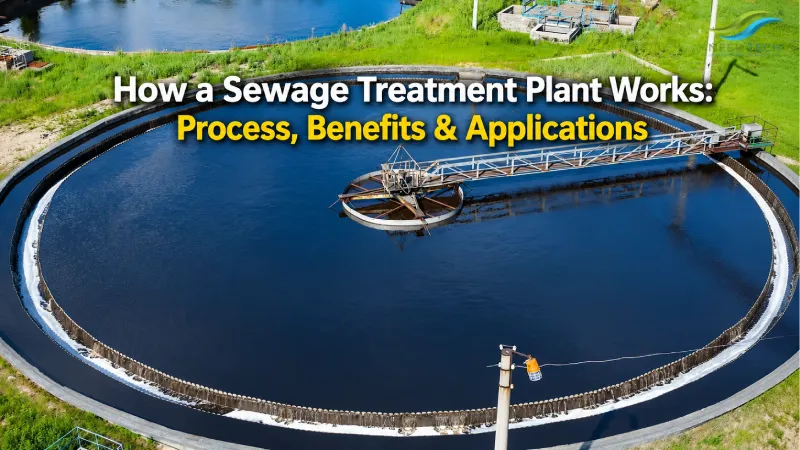
The pre-cleaned sewage now flows into large, calm sedimentation tanks. As the water sits with minimal movement, heavier organic solids gradually settle to the bottom as sludge. Oils and greases rise to the surface as scum. Both are removed mechanically. By the time water leaves primary treatment, around half to two-thirds of its suspended solids are gone — but biological contamination still remains, which is why the next stage matters so much.
Stage 3 — Secondary (Biological) Treatment
This is where the real transformation happens inside a sewage treatment plant. Secondary treatment uses living microorganisms — bacteria — to digest the dissolved organic matter that physical processes cannot remove. Aeration tanks are filled with air, which fosters the growth of aerobic bacteria that eat organic contaminants.
Different technologies are used at this stage depending on the project. MBBR (Moving Bed Biofilm Reactor) uses small plastic carriers that host biofilm colonies — flexible, reliable, and easy to scale. MBR (Membrane Bioreactor) combines biological treatment and membrane filtration in one compact unit, delivering exceptionally clean output. SBR (Sequencing Batch Reactor) runs in fill-and-react cycles within a single tank, making it a cost-effective choice for moderate volumes.After secondary treatment, key contamination markers like BOD and COD drop sharply. The water looks and behaves very differently from what came in.
Stage 4 — Tertiary Treatment
When the treated water needs to be reused — not just discharged — tertiary treatment takes it to the next level. Sand filters, activated carbon units, and UV disinfection systems remove what biological treatment leaves behind — residual pathogens, fine suspended particles, and trace chemical compounds.
Water leaving tertiary treatment is clean enough for irrigation, landscaping, toilet flushing, and cooling towers. It will not make anyone sick. It will not harm soil. This is the stage that turns a treatment plant into a water recycling asset.
Stage 5 — Sludge Management
The sludge collected at primary and secondary stages is not simply thrown away. It goes through its own treatment process — thickening, digestion, and dewatering. In anaerobic digestion systems, this sludge even produces biogas that can be used to partially power the plant itself. What remains after dewatering is often dried and used as compost or safely disposed of. Sludge management is a part of complete sewage treatment plant service that is often underestimated but never unimportant.
Technologies That Power a Modern STP
Choosing the right technology is one of the most consequential decisions when setting up a sewage treatment plant There is no single best answer — the right choice depends on the volume of sewage, available land, quality requirements for treated water, and budget.
MBR delivers the cleanest output and fits into tight spaces — making it ideal for urban high-rises and hospitals. MBBR handles fluctuating loads without losing performance — a strong fit for industrial campuses. SBR packs everything into one tank with timed cycles — compact and economical for mid-scale facilities. Tertiary filtration layers — sand, carbon, UV — are added when the treated water must meet reuse standards.
Getting this selection right requires people who have done it before. That is what experienced STP Plant manufacturers bring to the table — not just equipment, but the judgment to match the right system to the right project.
Real Benefits That Go Beyond Compliance
People often think of an STP purely as a regulatory box to check. That thinking undersells what these systems actually deliver.
Water can be reused. Treated effluent from a properly run sewage treatment plant can go back into the facility as flushing water, garden irrigation, or cooling. For large commercial buildings in water-scarce regions, this is a meaningful operational saving every single month.
Groundwater stays clean. When untreated sewage soaks into the ground, it poisons the water table beneath. Good treatment cuts off that chain before it starts.
Communities stay healthier. Waterborne diseases — cholera, typhoid, hepatitis A — trace back to contaminated water. A functional sewage treatment plant is a public health investment, even when nobody thinks of it that way.
Environmental credibility. Industries and developers face increasing scrutiny from regulators, investors, and local communities. A well-maintained STP demonstrates real commitment to environmental responsibility, not just paperwork compliance.
Cost efficiency over time. Modern automated plants consume far less manpower and optimize energy use. When supported by a reliable sewage treatment plant service team, the total cost of operation stays predictable and manageable.
Where Sewage Treatment Plants Are Being Used
The range of settings where a sewage treatment plant operates today is broader than most people realize. Residential townships and gated communities are among the most common — apartment complexes use treated water for common-area landscaping and flushing, visibly cutting their municipal water bills. Factories and manufacturing plants deploy STPs to handle worker facility sewage alongside process wastewater, meeting discharge norms for both. Hospitals require specialized STP systems with strong disinfection stages, given the biological hazards present in healthcare wastewater. Hotels and large commercial complexes recycle treated water for cooling towers, ornamental gardens, and service areas. Educational campuses, especially large universities, are increasingly installing modular STP systems as part of green campus initiatives. And of course, municipal bodies run large-scale plants serving entire city zones — often reusing treated water for road washing and urban horticulture.
Why Choose Us
Neer Tech has spent years working directly with clients across residential, commercial, industrial, and municipal projects — not just selling systems but building partnerships that last well beyond installation day. What sets Neer Tech apart from other STP Plant manufacturers is the depth of involvement at every project stage. The team starts with a thorough wastewater quality assessment, works through customized system design, handles all civil and mechanical engineering, manages fabrication and installation, and stays on through commissioning and after-sales support. No stage is treated as someone else's problem.Every sewage treatment plant built by Neer Tech is designed specifically for its site — the wastewater composition, the volume it needs to handle, the space available, and the end use of treated water all shape the final design. Whether it is a compact MBR unit for a high-rise in Ahmedabad or a large MBBR-based system for an industrial estate, Neer Tech brings the same level of technical rigour and transparency to the work. Clients know what they are getting, why it was designed that way, and what performance to expect from day one.
Conclusion
A sewage treatment plant is not complicated to understand when you break it down stage by stage — screening, settling, biological treatment, polishing, and sludge management. Each step handles something the previous one could not. Together, they turn hazardous wastewater into something the environment can safely receive, or a facility can productively reuse. The benefits — cleaner water bodies, healthier communities, regulatory compliance, water savings — stack up quickly. And with the right sewage treatment plant service partner handling design, installation, and maintenance, the system works the way it is supposed to, year after year. If you are planning an STP for any type of facility, start with the right conversation — about your wastewater, your site, and your goals.Take the Next Step Toward Cleaner, Smarter Water Management
If you are ready to install, upgrade, or maintain a sewage treatment plant for your facility, Neer Tech is here to help you get it right from day one.Call us: +917984377525 or write to [email protected].